
Pay Programs: Creating and Configuring Driver Pay
A pay program is a named pay policy — for example "Company Drivers" or "Owner Operators" — with its own rules, rate matrices, eligibility, and minimum-pay floors. Managers build programs under Driver Pay → Programs; drivers never see this page.
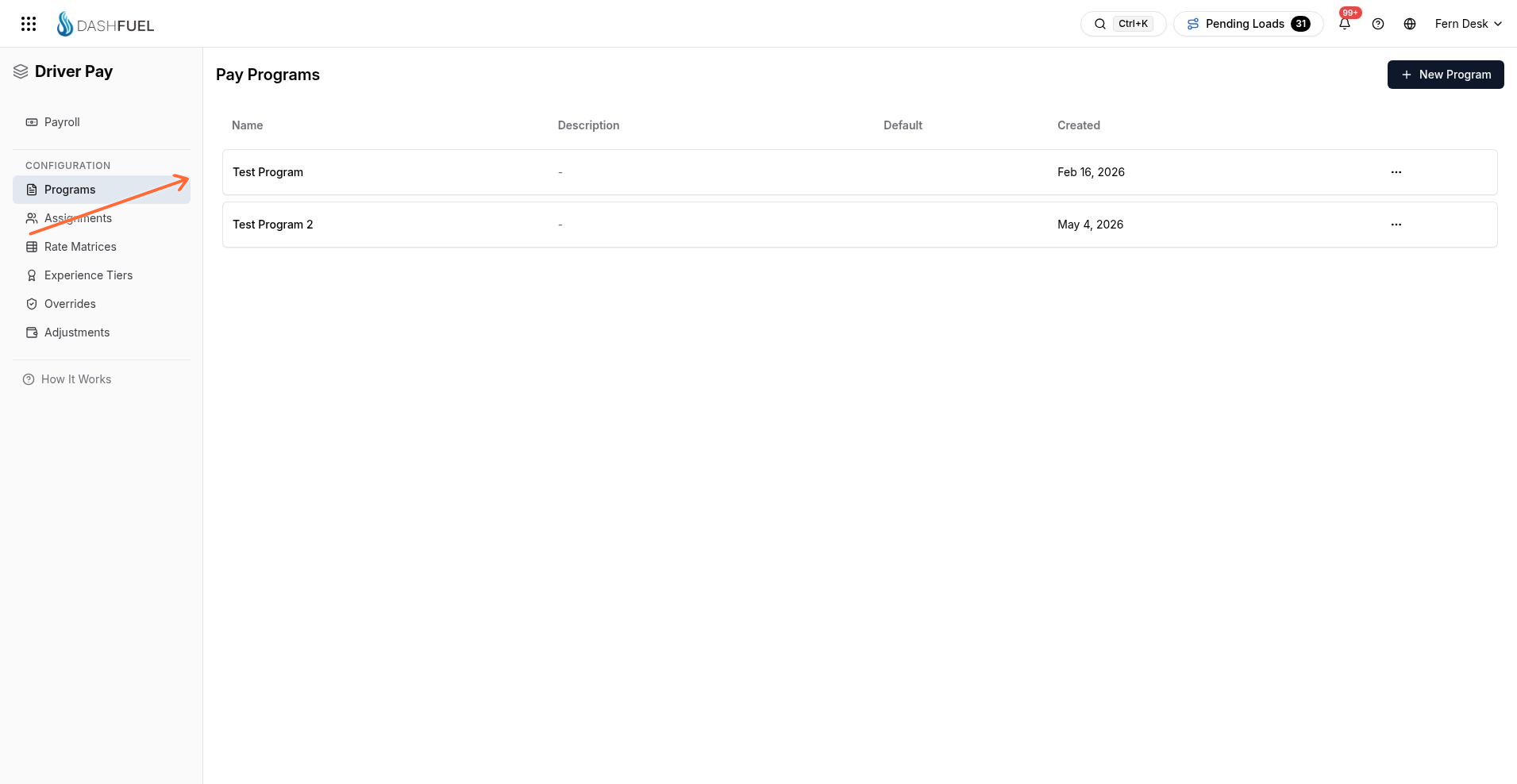
Programs and versions
Each program has a name, description, and a flag for whether it's the default (used when a driver has no active assignment). Inside a program, pay rules live on policy versions — dated snapshots of the rule set. Creating a new version lets you change rates or rules without rewriting history; deliveries settle against the version that was effective on their date.
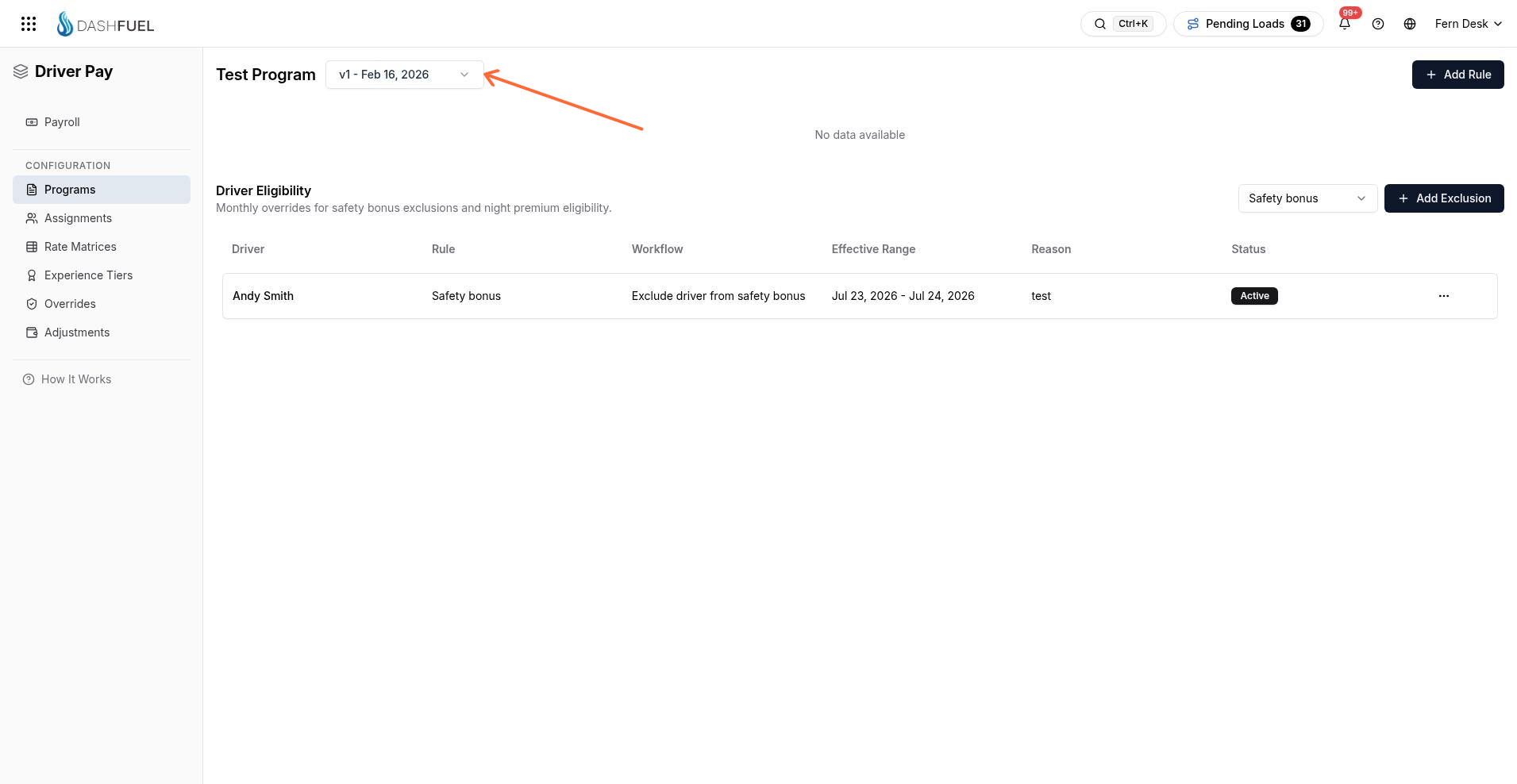
A program can also carry a minimum pay amount and period (daily, weekly, or monthly). When a driver's settled pay for that period falls short, payroll can generate a top-up — see Payroll: Reviewing and Exporting Driver Pay.
Driver eligibility
Eligibility controls who the program applies to when it's used as a default or matched automatically:
All drivers — no restriction.
Include only — a specific list of drivers.
Exclude — everyone except the listed drivers.
Explicit assignments always win over eligibility — see Rate Matrices and Driver Assignments.
Building the rule set
Rules are the building blocks of a version. Each rule has a type, a calculation method, and optional conditions (when it fires) and multipliers (how the amount is adjusted).
Rule type | What it pays | Typical methods |
|---|---|---|
Base pay | Primary pay for the delivery | Rate matrix lookup, per mile, per gallon, flat, hourly, percent of freight |
Safety pay | Safety bonus or stipend | Flat, percent, per unit |
Accessorial pay | Pay derived from freight accessorials on the load | Percent of accessorial, flat per accessorial |
Stop pay | Extra pay per stop on multi-stop loads | Flat per stop, after N free stops |
Other rule types cover night, weekend, holiday, and short-haul premiums, hourly pay tied to shift hours, and per-day / per-shift flat amounts.
Each rule can also set:
Stacking — whether it adds on top of other rules or replaces them.
Conditions — filters like fuel type, customer, terminal, mileage band, time of day, or day of week that must match for the rule to apply.
Multipliers — experience-tier or other factors that scale the calculated amount.
Minimum / maximum — floors and caps on that rule's contribution.
Base-pay rules that use a rate matrix look up the dollar amount from a matrix you attach to the program. Build those matrices first — see Rate Matrices and Driver Assignments.